
The Power Of Proactivity
If you want a calmer car, faster progress, and fewer last-minute scrambles before Part 3 or a Standards Check, make proactivity your core skill. Proactivity isn’t just “doing more”; it’s anticipating needs, making smart choices early, and creating the conditions where problems don’t appear in the first place. Think firefighters: they spend most of their time educating and preparing communities so they don’t have to fight fires. Great driving instructors do the same.
Why Proactivity Starts With You
Before we ever talk about pupils, look inward. Successful instructors:
- Audit their skills and wellbeing regularly (teaching strategies, risk management, time management, health).
- Prioritise development rather than waiting for a reattempt or a weak Standards Check to force action.
- Seek meaningful support beyond endless mock tests. Mocks have their place, but they’re a poor substitute for coaching that models how to adapt in the moment.
Proactivity is admitting, “I need to see what good looks like,” and organising that experience now, not later.
.


Choose Your Battles (and Your Pupils)
For Part 3s or Standards Checks, be selective. Pick learners who complement your teaching focus and have a backup plan if they can’t attend. Every effective instructor owns a toolbox of options— skills, topics, areas, levels of instruction—and proactively chooses the right combination they think they may need before the day. This does not mean that this is what you will end up doing, but just like a normal lesson, you will plan for what you think might happen and adapt to what actually does.
Control First, Educate Second
“Over-instruction” gets a bad rap. In reality, timely control followed by coaching keeps everyone safe and minds open.
Example: your pupil approaches a roundabout in third at a crawl. Don’t let them stutter through and “learn from the mistake” in live traffic. Prompt or intervene early (“Pop it into first”), then pull over or chat on the move to debrief the why and plan how to prevent it. Safety, mindset, then learning—that’s the order. Learners are less likely to learn from a mistake, than they will a positive experience of the same point.
Trust Your Instincts
Proactive instructors read the road and the pupil:
- Watch hands, feet, eyes, breathing—tiny cues tell you when help is needed.
- Intervene earlier than you would as a driver; your prompt has to be heard, processed, and acted on.
- Use broad, safety-led questions: “How are you going to keep this safe?” rather than late, single-action nudges like “Mirrors?”
The aim is to stop issues becoming ingrained patterns.
Plan at the End, Not the Start
The most effective lesson plans are agreed at the end of the previous lesson while insights are fresh. Celebrate what worked, name the next development need, and set a simple goal. That way, your next session starts at pace with a shared purpose—and your pupil begins to think proactively about their own driving.
Offer the Right Choices (Not Any Choice)
Asking “How much help do you want?” invites a default “None, just tell me if i get it wrong.” Instead, limit choices to two or three that will keep you, them and everyone else safe and in the learning zone, calibrated to their current ability:
- “I can prompt you when I’d start slowing for roundabout, based on whats going on around us—or I can prompt you to tell me the factors your considering when choosing your speed on approach?.” You’re still learner-centred; you’re just risk-aware and guiding toward success.
Build Reflection Loops
We learn faster from wins than from wounds. Weave micro-reflections through the drive:
- “How did it feel when you slowed earlier?”
- “What would you tweak next time on that approach?”
Use these to adjust the plan live. If a “blip” repeats, address it now with a targeted prompt or brief pull-in—not as a vague goal for “next week.”
Make CPD a Habit, Not a Panic Button
Proactive instructors sit in on other lessons and tests (with pupil expectations set from day one), and they ask trainers to model adaptation aloud—not just watch silently. The goal is to see decision-making in real time so you can replicate it under pressure. If your trainer’s default is to sit quietly, ask them to coach visibly and narrate their thinking.
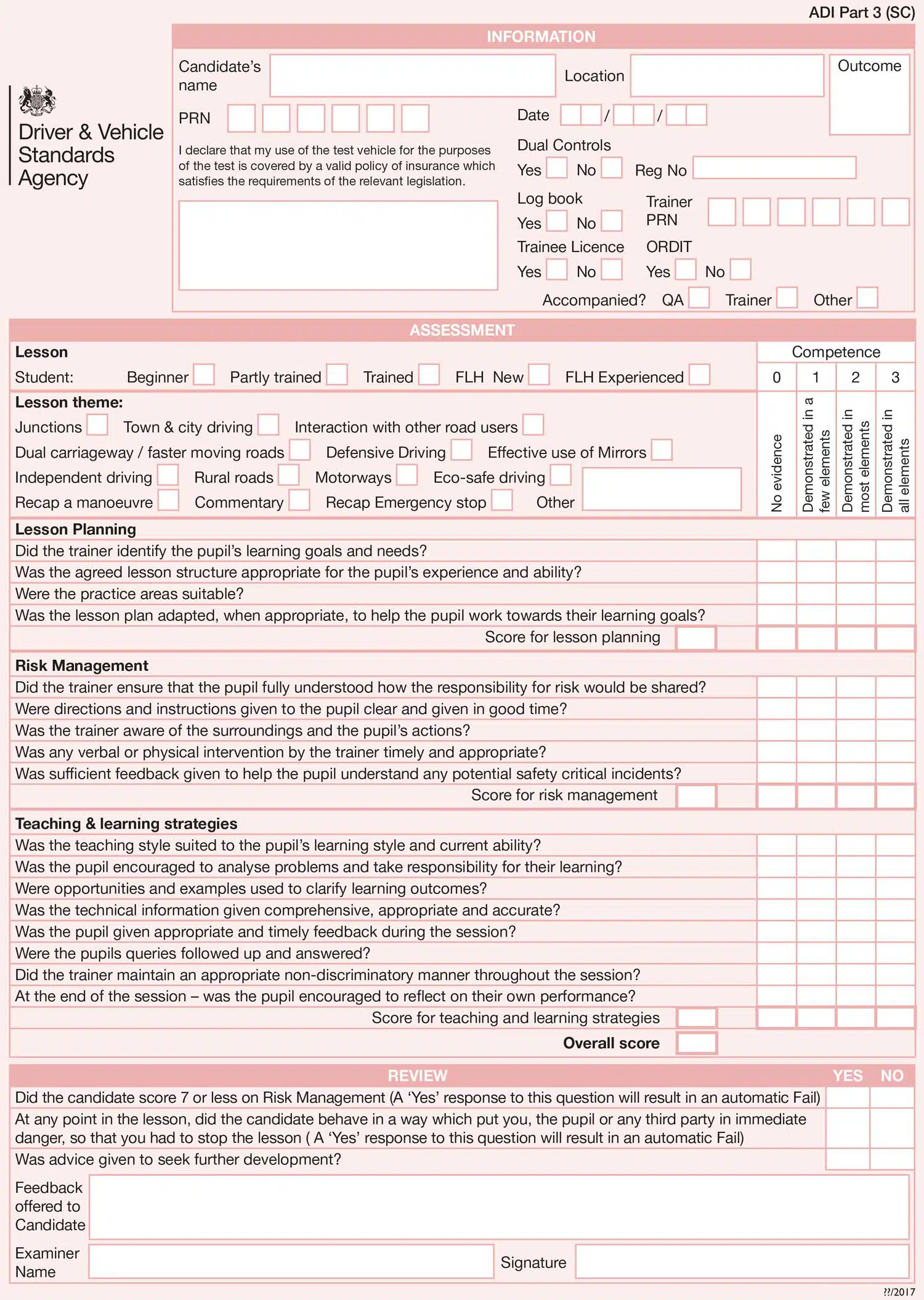
Proactivity Across the 17 Competencies
- Lesson Planning: Agree goals early, select suitable areas in advance, and adapt the plan as the pupil reveals new needs.
- Risk Management: Set clear expectations on shared responsibility, give timely instructions, and normalise early interventions for safety.
- Teaching & Learning Strategies: Match style to ability, scale support up or down proactively, and keep feedback timely and specific.
In short, treat proactivity as the “18th competency” that threads through all the others.
Quick Proactivity Checklist
-
□ I end lessons by agreeing the next goal and route ideas.
-
□ I can name two backup pupils for assessments.
-
□ I’ve mapped practice areas for each common need (emerging, hills, complex junctions).
-
□ I intervene early, then debrief the why.
-
□ I build reflection into the drive, not just the debrief.
-
□ I schedule regular sit-ins (giving and receiving).
-
□ I ask my trainer to demonstrate and narrate adaptive coaching.

Go Deeper, Build The Habit
If you want structured support to embed these habits, grab our Proactive Instructor course—it’s included in our mentorship for £30/month with a free 7-day trial. Prefer a one-off? You can also buy one of our bundles to focus on exactly what you need. Either way, you’ll get practical frameworks, real-world examples, and step-by-step support to become the instructor who’s always ahead.
Ready to swap firefighting for future-proofing? Start your free trial today or pick a bundle that fits your goals.
👉 Visit: inspireinstructortraining.com
📩 Or email: info@inspireinstructortraining.com
Let us know what landed with you, what tools you’re trying, or what pupil breakthroughs you’ve had recently. The conversation continues!
👉 [Join the Membership Today]
Because the more you understand how we learn, the better you teach—and the more lives you change.
*Free membership offered for 7 days