20 July 2026 · 7 min read · Business Development
The Driving Detective: Teaching Learner Drivers to Read the Road
As instructors, we spend a lot of time saying “take the next road on the left” or “second exit at the roundabout.” But every time we do the spotting for our pupils, we rob them of the chance to spot it themselves — and that gap shows up the moment they hit independent driving, the test, or their first solo drive.
The fix is a mindset shift I call becoming a driving detective. Instead of feeding directions, we teach learners to read the environment: the signs, the paint, the street furniture and the little decisions councils make that quietly tell you what’s coming. Once a pupil learns to hunt for these clues, their anticipation, scanning and planning improve on every road type — often without you saying a word.
This isn’t about re-teaching junctions or crossings from scratch. It’s a layer you add on top of what you already do, turning ordinary drives into a treasure hunt for information.
Junctions: the clues councils leave behind
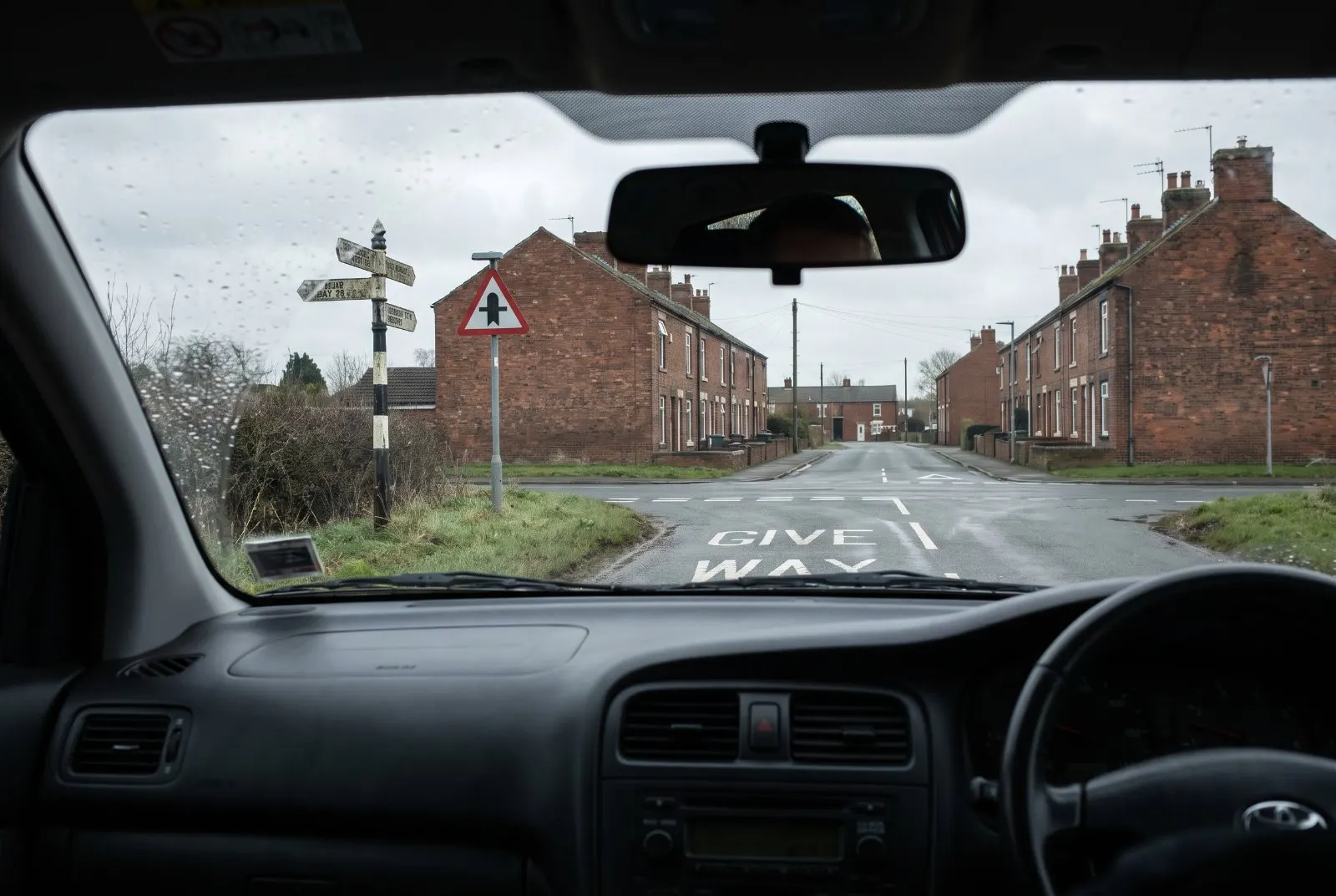
Try this: park near a crossroads that’s rich with detail and ask your pupil, “How do you know a junction is coming up?” They’ll start with the obvious — gaps in trees, gaps in houses. Then you guide them deeper into the clues most drivers never consciously notice.

- Yellow-backed signs — a yellow background means someone has been killed or seriously injured here. It’s the council’s way of flagging genuine, life-changing danger. Tie the warning to the sign: yellow behind a speed sign points to speed; yellow behind a crossroads sign points to the junction itself.
- Hazard lines vs centre lines — more paint on the road (longer lines, the word SLOW, solid lines either side) is the road shouting for attention.
- Red paint or red tarmac — increasingly used to highlight dangerous junctions. Ask pupils what red means everywhere else in life, and they’ll start seeing it everywhere on the road too.
- Hatch markings — down the centre of a long road, they warn of a right-turn area and a crossroads that might otherwise look like just another driveway.
- Double yellow lines — ask why the council spent money banning parking here but not at the junction behind. The answer usually reveals a busy road where parked cars are inevitable — perfect anticipation practice.
“The council never spends money without a reason. So why did they highlight this junction and not the last one? What do you think happened here?” That one question turns a passive pupil into an active investigator.
Then there’s the “free” street furniture that quietly marks nearly every junction. Point these out and your pupils will spot turnings long before the gap in the buildings appears:
Post boxes
Almost always sit right on the corner of a junction.
Electrical boxes
Those green or black cabinets service several streets — you’ll see them before the turn.
Bus stops
Sit immediately before or after a junction for accessibility.
Lamp posts
Councils place a lamp directly opposite junctions — sometimes a different colour bulb for danger.
Add dropped or curved kerbs|/strong>, bumps in the road for visual impairments, and thick black bollards on a corner — little exclamation marks warning of a narrow road that may need first gear. Stop signs deserve a mention too: teach pupils to stop at the line, not the sign (the sign is often set well back), and remember stop signs only appear reactively, after a serious incident. That’s why you never see them in new-build estates.
When a pupil spots the double yellows and correctly predicts the parked cars around the blind bend, that little smug moment is worth a hundred directions from you.
Lights and crossings: what the road is really telling you
The key message here isn’t the names of the crossings — it’s the difference between a traffic light and a pedestrian crossing, because it changes how a driver should think.
Pedestrian crossings always have zigzag lines. Traffic lights mostly have double yellow lines. That subtle difference tells the pupil what’s likely to change and why. Traffic lights are controlled by traffic — a timer or the volume of cars. A pedestrian crossing only changes when someone has pressed the button… but be careful with that logic.
“Only changes when people are there” gives a false sense of safety. Someone may have pressed the button and walked off, or nipped back into a shop. Teach pupils to look for the red illuminated ring on the button or the lit WAIT sign — an early tell that the lights are about to change even when no one’s in sight.
Integrated crossings at traffic-light junctions catch pupils out most. Turning right on a green, they’ll sometimes panic and stop for a red pedestrian light. Help them understand: once they’re past the stop line they’re in “no man’s land” and must make progress — that red no longer applies to them. It stops a dangerous slam-on just as they’re committing to the turn.
Finally, an isolated crossing in a quiet spot with no footfall is a clue in itself. The council wouldn’t fund it without demand — so scan ahead for a concealed park entrance or footpath, and be ready for a cyclist or pedestrian to appear at speed from a narrow path.
Towns, buses and the story the shops tell
Take a pupil into a side street off a high street — far enough that they’ve forgotten where they are — and ask what clues up ahead tell them it’s a pedestrianised area. The type of shops is a giveaway: Greggs, card shops, charity shops and hairdressers all signal high footfall. That head-start lets them own their speed and scanning before someone steps out of a blind, brick-walled gap.
Following a bus is another detective moment. How does it differ from following a car? How busy does the stop look, and how many people are still waiting to board? The old tell of “someone standing up” barely works now with push-button systems — so teach the expectation that it’ll pull over anyway, and a plan for going around it safely.
Rural roads: why the number on the sign is a story
Country roads are our most dangerous — mostly national speed limit. The unlock for pupils is this: every UK road starts at national speed limit until the council has a reason to lower it. Those reasons are access points and traffic — driveways, farms, houses, junctions.
So a 50 limit on a rural road is a warning that a junction or farm entrance is likely ahead. Houses appearing in the distance signal a drop to 30 or 20 long before the sign — and the road narrowing confirms it. Read those clues and you smooth out the panic-braking.
Roadside reflective marker posts help you trace the road’s edges in the dark: red reflectors sit on the near side (your left) and white reflectors on the off side (your right). A reliable orientation aid when there’s no street lighting — and a reminder that it’s not a safe place to pull over.
A couple of bonus clues: on the motorway, a bridge over the carriageway often sits just before a slip road — an early warning that cars may want to merge. And never underestimate the weather: a sunny day means more cyclists, dog-walkers and children heading to the park, while bad weather changes visibility, hoods and umbrellas. Reading the environment is reading the people in it.
Bringing it into your lessons
You don’t need a new syllabus for this — you need better questions. Park up somewhere rich with clues, ask “how do you know?”, and let the pupil investigate. The magic of the driving detective approach is that once a learner starts noticing these clues, they can’t stop. They’ll point out red tarmac, yellow-backed signs and post boxes on every drive, and with each spot their anticipation and confidence grow.
That’s the goal: not a driver who follows your directions, but one who reads the road for themselves — long after the L-plates come off.
Turn coaching theory into confident teaching
Inspire Instructor Training helps ADIs and PDIs master client-centred, detective-style coaching that sticks. Join the mentorship and get practical tools you can use in your very next lesson.
Explore Inspire Instructor Training →